


Digital solution · SaaS or On-Premise
The power of SoReady. The context of your event.
Parameters, business functions, algorithms, calculation engines, databases, MCP connectors and AI: SoReady brings the building blocks of event management together in a solution personalised and contextualised for each event. Your rules, venues, teams and goals define how it works.
SoReady
Questions & Answers
These initial topics explain our approach. Have a different question? Let’s discuss your project. Discuss your needs
How do you approach international federations and their rules?
Our work starts with official IF sources: rules, annexes, versions and errata. Requirements are qualified by discipline, level, category and effective period, then connected to the relevant venues, equipment, teams and checks. Binding interpretations remain subject to expert approval.
What does sporting risk assessment cover?
It examines hazards associated with a discipline and its configuration: course, field of play, warm-up, weather or medical resources. The work connects initial risk, people exposed, controls, owners, evidence and residual risk. Risk acceptance and operational authorisation belong to the authorised decision-makers.
Why use several AI models?
To separate roles: document extraction, source research, critical review, simulation and summarisation. Disagreements and uncertainty must remain visible. Business engines calculate; AI assists analysis and proposals; authorised people approve. Models and deployment modes are selected for the data and use cases.
How can a rule change affect schedules or budgets?
The approach connects a requirement to the affected discipline, field of play, equipment, team and time slot. A change therefore informs an impact analysis covering resources, costs and risks. Proposed changes are checked and approved before application; sources and decisions remain traceable.
Must we replace our tools?
Scoping identifies the exchanges needed with your tools and the systems that remain authoritative. Integrations are agreed with your leads.
Can we start with one issue?
A challenge, venue or milestone can be the starting point. Conditions for extending the scope are then defined from the results reviewed together.
Are all modules available?
Actual availability, required data and integrations are confirmed for your project before any commitment.
Can AI approve a decision?
It makes proposals and helps examine information. Authorised people retain responsibility for decisions and approvals.
How are price and timing determined?
They depend on the assignment, modules, integrations and deployment selected. Infrastructure provision and operation are specified separately in the contract.
Does SoReady require cloud AI?
No. The target architecture supports local or private models and processing. External AI is configured according to the client’s data and permissions; it is not required for Core’s business functions.
What happens when AI is unavailable?
Core’s essential functions are designed to remain usable: budgets, scheduling, rules, document management, workflows and reporting. Assistants show their unavailable status; missing outputs are never treated as approved. This independence is verified during acceptance testing.
Does LSE provide hosting?
Only where the contract includes it. Infrastructure may be supplied by the client or an agreed operator. Responsibility for hosting, operation, backups, security and service levels is explicitly assigned.
ONE PLATFORM · TWO COMPLEMENTARY ROLES
Your operations stay in control.
Core runs the business functions. Intelligence enriches the analysis. Permissions, rules and human approval connect the two.
CALCULATE · ORGANISE · RECORD
SoReady Core
Deterministic functions to support operational commitments.
- Budgets & costs
- Workforce & assignments
- Scheduling & contention
- Risks & infrastructure
- Documents & reporting
- Workflows, rules & audit
RESEARCH · UNDERSTAND · PROPOSE
SoReady Intelligence
Assistants that connect your documents, constraints and operational impacts.
- Document analysis with sources
- Cross-functional correlations
- Specialist agents
- Comparison of AI analyses
- Proposals for human approval
- Local or private processing
You retain the decision.
AI explains, researches, compares, correlates and proposes. Business engines calculate. People approve.
Explore Intelligence’s capabilities
Capabilities designed for native integration with SoReady, enabled to meet your needs and assessed for your environment.
Local LLMs
Explain and analyse using authorised resources, including without external AI APIs.
Document RAG
Search authorised documents and cite the passages used.
Embeddings
Find related content by meaning, with the same confidentiality rules as the documents.
OCR & document understanding
Cross-check several engines where included, extract text, tables and requirements, and retain original pages and discrepancies for verification.
Assistants & specialist agents
Support each function with a defined task and limited permissions.
Governed MCP interfaces
Control access to tools and data, log actions and submit changes to the required approvals.
Cross-model AI analysis
Compare local or authorised AI analyses, using structured choices where useful; expose sources, confidence, disagreements and uncertainty.
Business correlations
Connect requirements, resources and signals to explain possible impacts that need verification before a decision.
Target architecture · capabilities and conditions agreed per project
A rule only makes sense in context.
From local competitions to international elite events, Olympic or non-Olympic: requirements are qualified for each profile. Coverage and rule validity must be verified, never assumed.
Risks & readiness evidence
A mandatory access test is missing: a favourable average elsewhere cannot make the venue ready.
Explore the Risks & readiness evidence module ↗- 01Source
- 02Need
- 03Resources
- 04Check
- 05Decision
Solution in development. The capabilities shown describe the target architecture; the modules, AI modes and deployment options actually supplied are assessed and acceptance-tested for each project.
SoReady · 01
Prepare resources and schedules.
Open a card to see its role, an example, the people involved and the evidence needed for a decision.
Rules & disciplines
Link each requirement to the discipline, level, age group and period of applicability.
Explore the Rules & disciplines module ↗02Documents, OCR & sources
Make documents searchable while retaining their origin.
Explore the Documents, OCR & sources module ↗03Venues, capacity & equipment
Distinguish declared capacity from verified, genuinely available capacity.
Explore the Venues, capacity & equipment module ↗04Planning & contention engine
Detect incompatible commitments for places, teams or equipment, including transitions.
Explore the Planning & contention engine module ↗05Teams, officials & volunteers
Cross-check qualifications, authorisations, availability, rest and assignments.
Explore the Teams, officials & volunteers module ↗06Budget, procurement & shared resources
Control and optimise the budget by linking needs to costs and commitments.
Explore the Budget, procurement & shared resources module ↗SoReady · 02
Coordinate operations and decisions.
Open a card to see its role, an example, the people involved and the evidence needed for a decision.
Risks & readiness evidence
Separate demonstrated readiness from risks still requiring monitoring.
Explore the Risks & readiness evidence module ↗02Welcome & event services
Connect ticketing, accreditation, accommodation, catering, transport and media to the programme.
Explore the Welcome & event services module ↗03Feeds, EDF & EOS
Qualify signals, correlate them and present their operational consequences.
Explore the Feeds, EDF & EOS module ↗04AI & human decisions
Research, explain, compare and correlate information, then propose an evidence-based decision with local, private or hybrid AI.
Explore the Local AI & human decisions module ↗05Reporting & lessons learned
Prepare readable summaries and retain the reasons behind decisions.
Explore the Reporting & lessons learned module ↗06Governance & confidentiality
Define who may view, propose, approve and administer each scope.
Explore the Governance & confidentiality module ↗07Portals & module activation
Configure each client’s workspaces, events and permissions for the chosen deployment.
Explore the Portals & module activation module ↗AI WHERE YOU CHOOSE
Your data. Your environment.
Local, private cloud, hybrid or authorised external AI: choose according to data sensitivity, use cases and operating requirements.
01Local / on-premise AIAnalyse sensitive data on site.
Models, documents, indexes and processing are designed to remain within the client’s environment. Fully local operation is assessed against the resources, dependencies and maintenance required.
02Private cloud AIWork in a controlled environment.
Processing uses private or dedicated infrastructure. The operator, locations, access and responsibilities are defined; a private environment alone does not guarantee sovereignty.
03Hybrid AIDecide what stays local and what may move.
Sensitive data stays within its authorised scope. Every exchange between environments follows an explicit policy for classification, permission and traceability.
04Controlled external AIChoose a complementary capability.
An external service may be authorised for specific uses and data. It is neither a prerequisite for Core nor a mandatory route for Intelligence; activation depends on the agreed scope.
Confidentiality and sovereignty require deliberate choices: processing locations, operators, access, models and permitted data flows are assessed. The architecture aims for portability and supplier choice rather than dependence on a single provider.
Portable software. Defined responsibilities.
SoReady is designed for deployment on client infrastructure: on-premise, in a private cloud, on dedicated infrastructure or in an operated environment. LSE’s provision of hosting and its operation depend on the agreed contractual scope.
WORKSPACES & MODULES
Your organisation. Your events. The modules you need.
A client portal brings together authorised events. Global administration prepares workspaces, roles and modules on the chosen infrastructure. Permissions, dependencies and acceptance criteria are checked before activation. The commercial model, including SaaS where agreed, does not by itself determine who provides hosting.
- 01Organisation
- 02Event
- 03Modules & rights
- 04Acceptance
- 05Activation
Governance & confidentiality
Define who may view, propose, approve and administer each scope.
Explore the Governance & confidentiality module ↗Portals & module activation
Configure each client’s workspaces, events and permissions for the chosen deployment.
Explore the Portals & module activation module ↗Solution in development. The capabilities shown describe the target architecture; the modules, AI modes and deployment options actually supplied are assessed and acceptance-tested for each project.
See the functions in context.
Functional illustrations: the screens alone do not establish module availability.

Planning & contention engine ↗
Detect incompatible commitments for places, teams or equipment, including transitions.

Documents, OCR & sources ↗
Make documents searchable while retaining their origin.

Venues, capacity & equipment ↗
Distinguish declared capacity from verified, genuinely available capacity.

Teams, officials & volunteers ↗
Cross-check qualifications, authorisations, availability, rest and assignments.
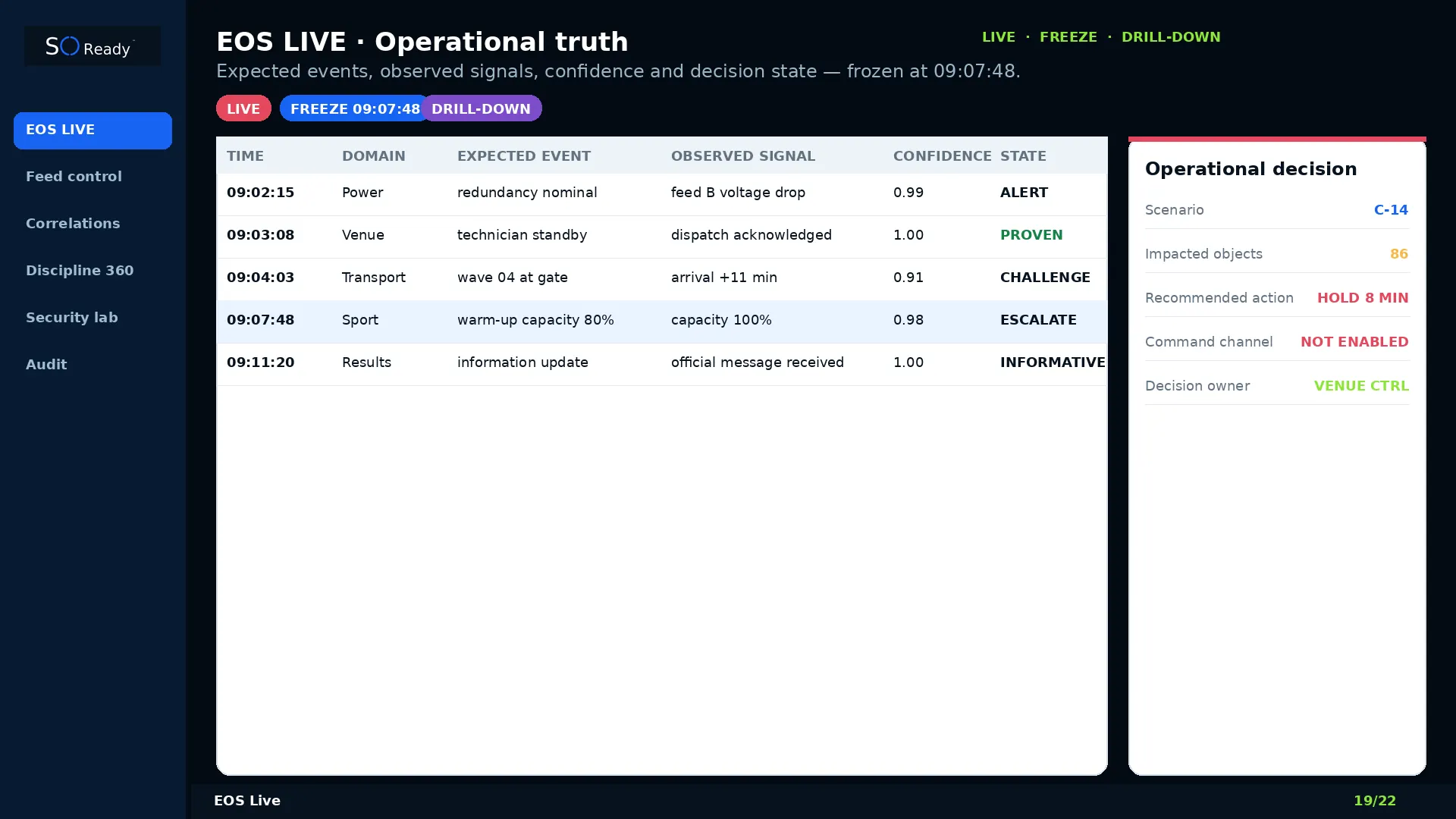
Feeds, EDF & EOS ↗
Qualify signals, correlate them and present their operational consequences.

Reporting & lessons learned ↗
Prepare readable summaries and retain the reasons behind decisions.
LET’S DISCUSS YOUR EVENT
A need. A deadline.
A useful first conversation.
Tell us about your event, your role and the situation to examine. We can then agree the scope, deliverables and conditions for the next step.
Describe your needs without sending sensitive or confidential data.