
SoReady · EDF / EOS
Feeds matter when their consequences are connected.
A transport delay affects more than mobility: it may delay a shift, block preparation and threaten a competition start. SoReady connects signals and shows what needs checking.
SoReady · Event Data Fabric
The flow model, in action.
Explore feed families, open operational views and follow correlations. Feeds are named by function; locations are labelled Cluster 1, 2, 3… and Site 1, 2, 3…
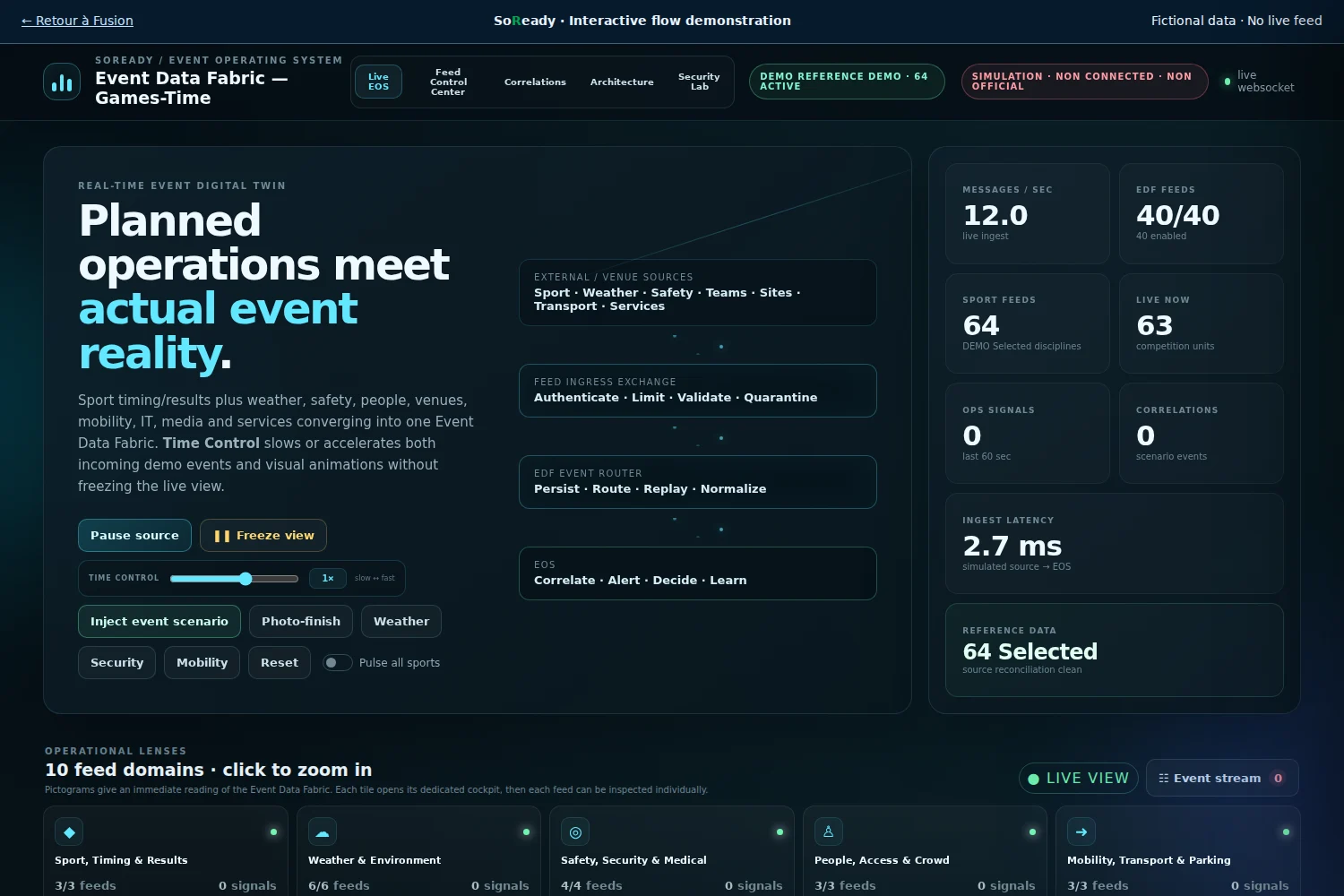
Simulation with fictional data · English interface
Qualify information before raising an alert.
EDF distributes qualified information; EOS gives teams an operational view. Incoming data does not directly modify reference data. Official emergency response chains remain autonomous.
SoReady · EOS
Follow the signal. Freeze the view. Trace the source.
Guided simulation: advance one signal at a time. The frozen view retains the same snapshot; new signals wait until you resume. No live feed is connected.
EOS
More information needed
15:00 · Current view
The planning case uses a different trigger: competition A starts 30 minutes late. It does not automatically turn these signals into a new schedule.
03 / CORRELATE THE FEEDS
Connect a signal
to the affected activities.
Information becomes useful when you know where and when it applies, how reliable it is and which resources it concerns.
What needs coordinating
Athletes, officials, staff, volunteers, spectators, equipment and services: movements, duty times and capacities.
What informs the situation
Timestamped information from operational tools, facilities and the field, linked to the schedule and applicable rules.
These situations illustrate the catalogue. Selecting one does not change the schedule scenario above.
A delay reported from the field, alongside a disruption on the route.
Required cross-check
Same group, journey, venue and duty; timestamp and provenance for each input.
Will the team be ready on time, or is an authorised relief team needed?
- Traffic and road restrictions
- Accreditations and access rights
- Teams, assignments and shift attendance
- Operational radio communications
The schedule, documented rules and contracts form the internal project context. They are not counted as additional feeds.
Officials’ access, preparation, competition A and the next assignment at venue B.
Sport, transport and venue operations
Correlation helps direct the checks. On its own, it does not establish the cause of an incident.
INFORMATION THAT SUPPORTS THE ANALYSIS
Choose a family.
See the information involved.
Select the information relevant to your event. The catalogue describes 40 feed types across 10 families; sources, permissions and integrations require project-specific qualification.
Open the detailed catalogue
40 · feed types
Sport & results
- Sports results and statuses
- Photo finish and finish evidence
- Score displays
To qualify for each project
Weather & environment
- Local weather alerts
- Regional weather alerts
- Hourly weather forecasts
- Ground weather observations
- Precipitation radar
- International weather exchanges
To qualify for each project
Security, emergency & medical
- Video monitoring of areas
- Emergency and medical availability
- Response dispatch
- Fire alarms
To qualify for each project
People, access & crowds
- Accreditations and access rights
- Ticketing and attendance
- Teams, assignments and shift attendance
To qualify for each project
Mobility & parking
- Real-time public transport
- Traffic and road restrictions
- Parking occupancy
To qualify for each project
Venues & facilities
- Venue environmental sensors
- Building management
- Technical equipment status
- Electrical power
- Water and sanitation
- Lifts and vertical circulation
- Area lighting
To qualify for each project
IT & clocks
- Platform health
- Clock synchronisation
- Network equipment monitoring
- Technical logs
- Network data traffic
- Cybersecurity alerts
To qualify for each project
Logistics & services
- Deliveries, stocks and traceability
- Cleaning and waste collection
- Catering and food service
To qualify for each project
Media & audiovisual
- Video routing and availability
- Audio distribution
- Media distribution status
To qualify for each project
Communications & public signals
- Operational radio communications
- Public online signals
To qualify for each project
View the 16 defined use cases
- Thunderstorm and outdoor activities
- Late arrival of athletes or officials
- Several network feeds deteriorating together
- Entrance congestion and an access incident
- Heat, medical capacity and staff shortage
- Conflicting result and finish evidence
- Deteriorating media distribution
- Fire and an impaired evacuation route
- Cyber incident and the results system
- Compromised field-of-play transition
- Deteriorating water or sanitation
- Insufficient lighting
- Parking, traffic and a crowd peak
- Clock mismatch
- Network, displays and result reliability
- Suspect feed isolated, reconciled before reintegration
The catalogue does not mean every connection is available. Two signals occurring close together do not prove a causal relationship.
LET’S DISCUSS YOUR EVENT
A need. A deadline.
A useful first conversation.
Tell us about your event, your role and the situation to examine. We can then agree the scope, deliverables and conditions for the next step.
Describe your needs without sending sensitive or confidential data.